When Killing Humans Becomes a Safari: Slavoj Žižek on Sarajevo Safari and the Logic of Distance
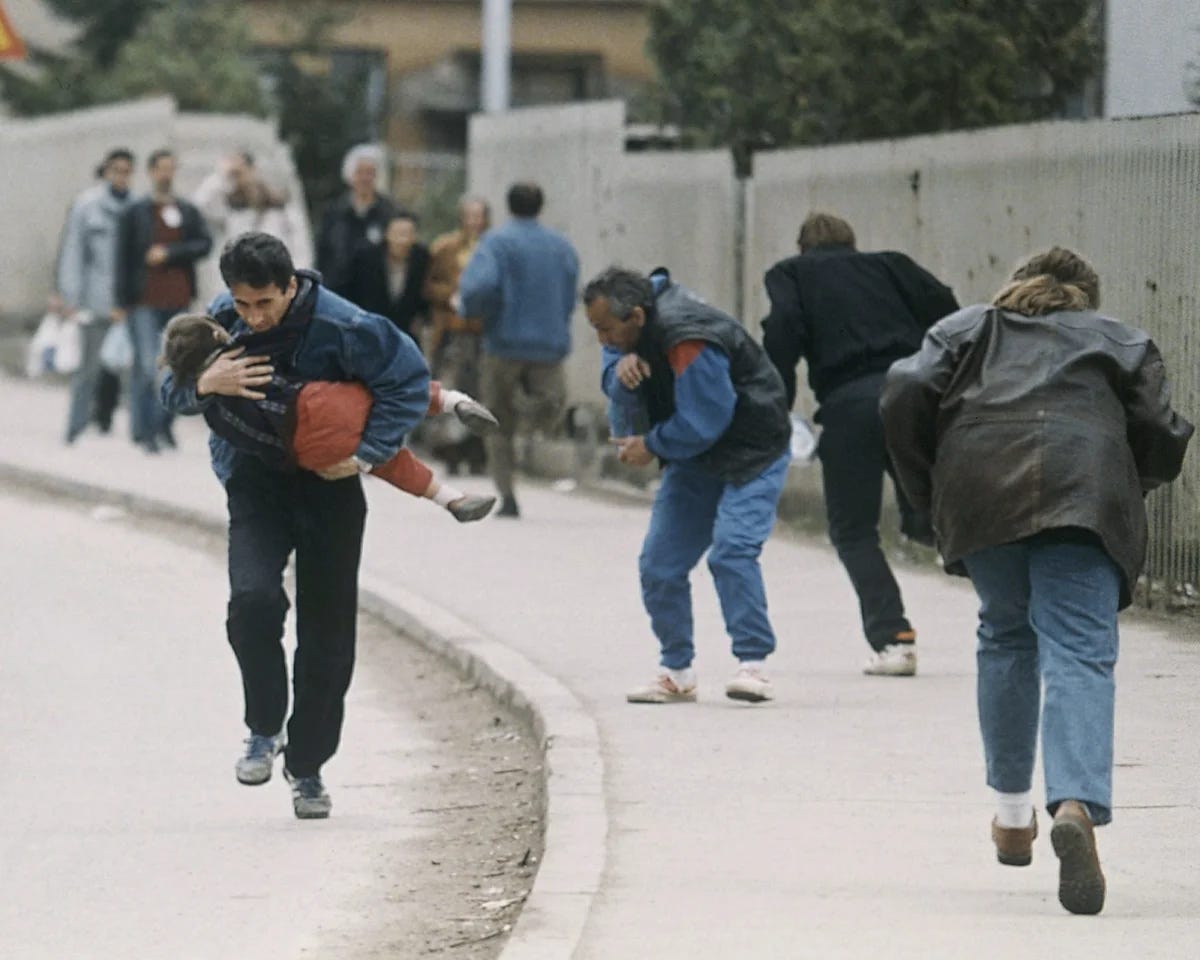
In this commentary, Slavoj Žižek discusses the documentary Sarajevo Safari and the disturbing idea that wealthy foreigners paid to shoot at civilians during the siege of Sarajevo. He uses the example to explore a psychological and political pattern in which perpetrators place themselves at a safe distance from reality, allowing violence to feel unreal, anonymous, and morally detached. Žižek contrasts this with The Act of Killing, where perpetrators openly boast about past crimes, and extends the argument to contemporary political rhetoric that treats mass death as something others will absorb. The piece focuses on the subjective position of those who speak and act from a removed vantage point, as if they are not fully part of the world they are endangering.
Sarajevo Safari and the ‘hunter’ at a distance
Žižek describes Sarajevo Safari as a documentary about a reported wartime phenomenon in which foreign visitors allegedly paid to shoot at civilians in besieged Sarajevo. His focus is less on the sensational detail than on the structure of the act: the victim remains anonymous, the shooter is shielded from direct contact, and violence becomes a spectacle experienced from safety.
Why this is different from The Act of Killing
He compares Sarajevo Safari to The Act of Killing, which shows perpetrators of mass violence openly celebrating and reenacting their crimes. In Žižek’s view, that film deals with crimes already committed, while Sarajevo Safari presents killing itself as an organized spectacle, which he sees as an even more disturbing form of detachment.
From war crimes to modern power
Žižek broadens the argument by suggesting that similar logic can appear in corporate and political decision-making, where people in positions of power can ruin lives while remaining insulated from consequences. He also cites recent statements by Dmitry Medvedev as an example of rhetoric that treats catastrophic escalation as something borne by others, not by the speaker.
The central question of responsibility
Across these examples, Žižek returns to a shared theme: the willingness to act as though one stands outside the social and material reality affected by one’s decisions. The essay asks what it means when violence, destruction, or even nuclear threat is imagined from a position of safety and distance.
Key takeaways
- Sarajevo Safari is presented as an extreme case of violence turned into a spectacle.
- Žižek argues that distance from the victim helps perpetrators avoid shame and responsibility.
- He contrasts anonymous, real-time killing with the open boasting shown in The Act of Killing.
- The essay extends the same logic to political and corporate power.
- A central concern is the fantasy of acting from outside the reality one helps shape.
Summary based on Slavoj Žižek’s article ‘WHEN KILLING HUMANS BECOMES A SAFARI’ published at https://slavoj.substack.com/p/when-killing-humans-becomes-a-safari-574 on 2026-07-29. Read the original post on Substack.