Against Poetocracy: D’Annunzio’s Fiume, Fascist Aesthetics, and the Politics of Poetry
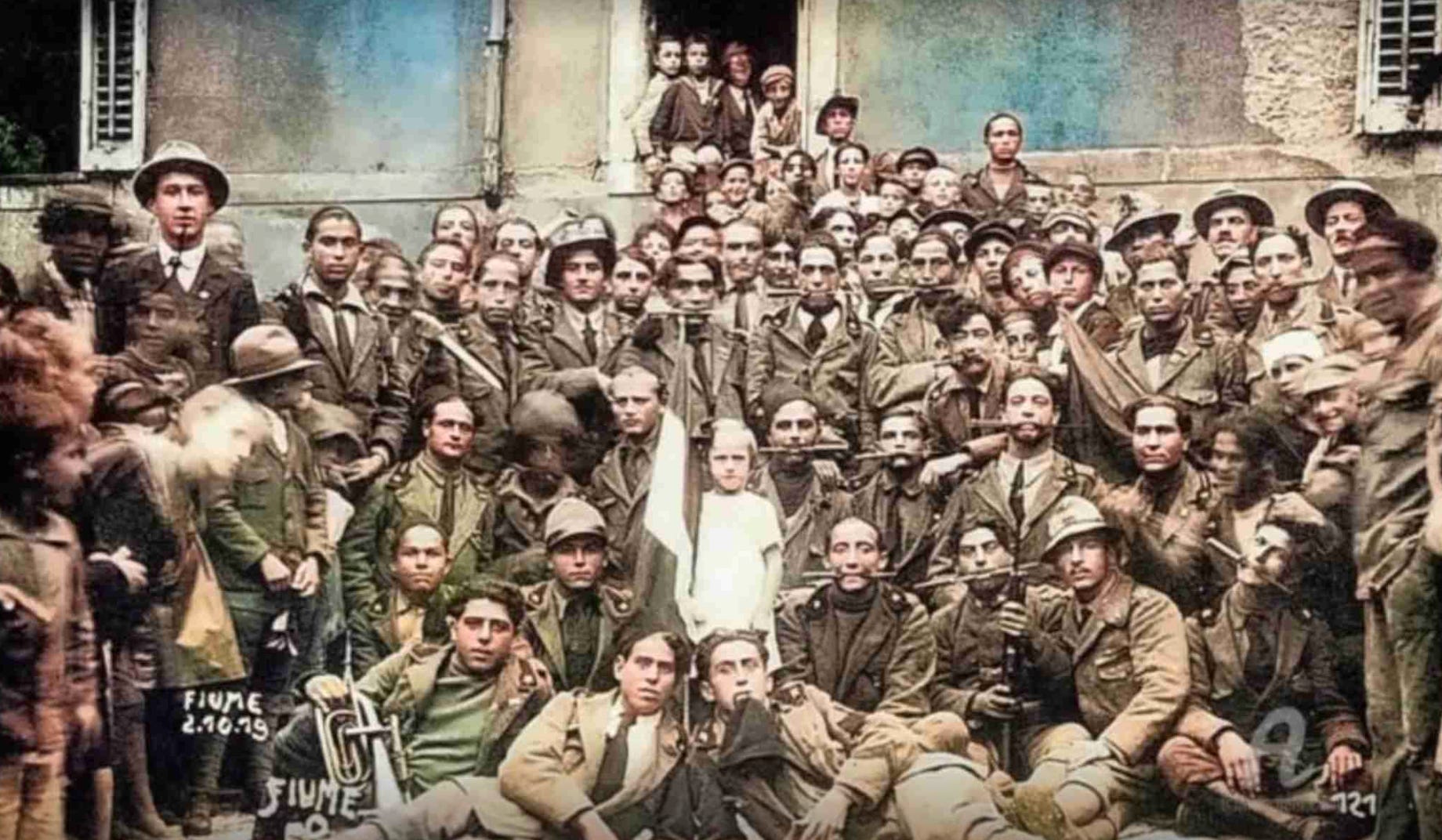
In this essay, Slavoj Žižek revisits the short-lived Free State of Fiume, the dramatic political experiment led by Gabriele D’Annunzio in 1919–1920. Using the documentary Fiume o Morte as a starting point, he presents Fiume as a bizarre mix of revolutionary rhetoric, erotic liberation, theatrical politics, nationalism, and anti-bourgeois spectacle. He argues that the episode cannot be reduced to simple proto-fascism, since it also contained genuinely disruptive and even emancipatory elements, but that its poetic intensity was inseparable from violence and political instability. Žižek ultimately turns to Plato to argue that poetry can help fuel dangerous political fantasies, linking the “poetic regime” of Fiume to fascist aesthetics and, provocatively, to the surreal excesses of contemporary AI and tech power.
Fiume as a political and aesthetic experiment
Žižek describes D’Annunzio’s occupation of Fiume as an extraordinary historical interlude: a city-state shaped by war, rebellion, spectacle, and artistic self-invention. He stresses that D’Annunzio was not just a poet but a celebrity figure whose politics, performances, and image-making helped define the experiment.
Revolution, liberation, and contradiction
The essay emphasizes the strange mixture of elements inside Fiume: anarchists, syndicalists, fascists, and communists; egalitarian constitutional language; sexual liberation; nudism; and a cult of beauty and action. Žižek notes that these progressive features coexisted with nationalism, militarism, and eventually ethnic exclusion.
Why Fiume cannot be read as simple proto-fascism
Žižek argues that Fiume should not be treated as a straightforward path to fascism. Instead, he sees it as a volatile ideological blend whose subversive core was later repressed when fascism became fully consolidated. In his reading, the Italian army’s bombardment of Fiume ended not just a chaotic regime but a dangerous political-aesthetic experiment.
Poetry, ideology, and Plato’s warning
The essay turns to the role of poetry in politics. Žižek claims poetry can make the cruelty of war emotionally and imaginatively powerful, which is why he invokes Plato’s suspicion of poets. For Žižek, poetic imagination can nourish destructive political fantasies, especially in confused ideological situations.
From Fiume to AI and tech power
In the final move, Žižek connects Fiume’s ideological incoherence to artificial intelligence, suggesting that AI resembles a messy, inconsistent, hallucination-prone construct. He ends with a provocative comparison: just as D’Annunzio embodied a poetic-political excess, contemporary figures like Elon Musk and Peter Thiel are cast as modern equivalents.
Key takeaways
- Fiume was a short-lived political experiment combining radical rhetoric, spectacle, and aesthetic experimentation.
- Žižek argues that Fiume cannot be explained as merely proto-fascist; it also contained destabilizing and emancipatory impulses.
- The essay links poetry to political danger, using Plato to argue that poetic fantasy can corrupt public life.
- Žižek connects the logic of Fiume to fascist aesthetics and, more broadly, to the incoherence of contemporary AI systems.
- The piece ends with a sharp comparison between D’Annunzio and modern tech elites.
Source: Slavoj Žižek, “AGAINST POETOCRACY,” published on Substack on 2026-10-21. Read the original at https://slavoj.substack.com/p/against-poetocracy-6e4 Read the original post on Substack.