Slavoj Žižek on France’s 2026 Protests, Populism, and the Limits of Representation
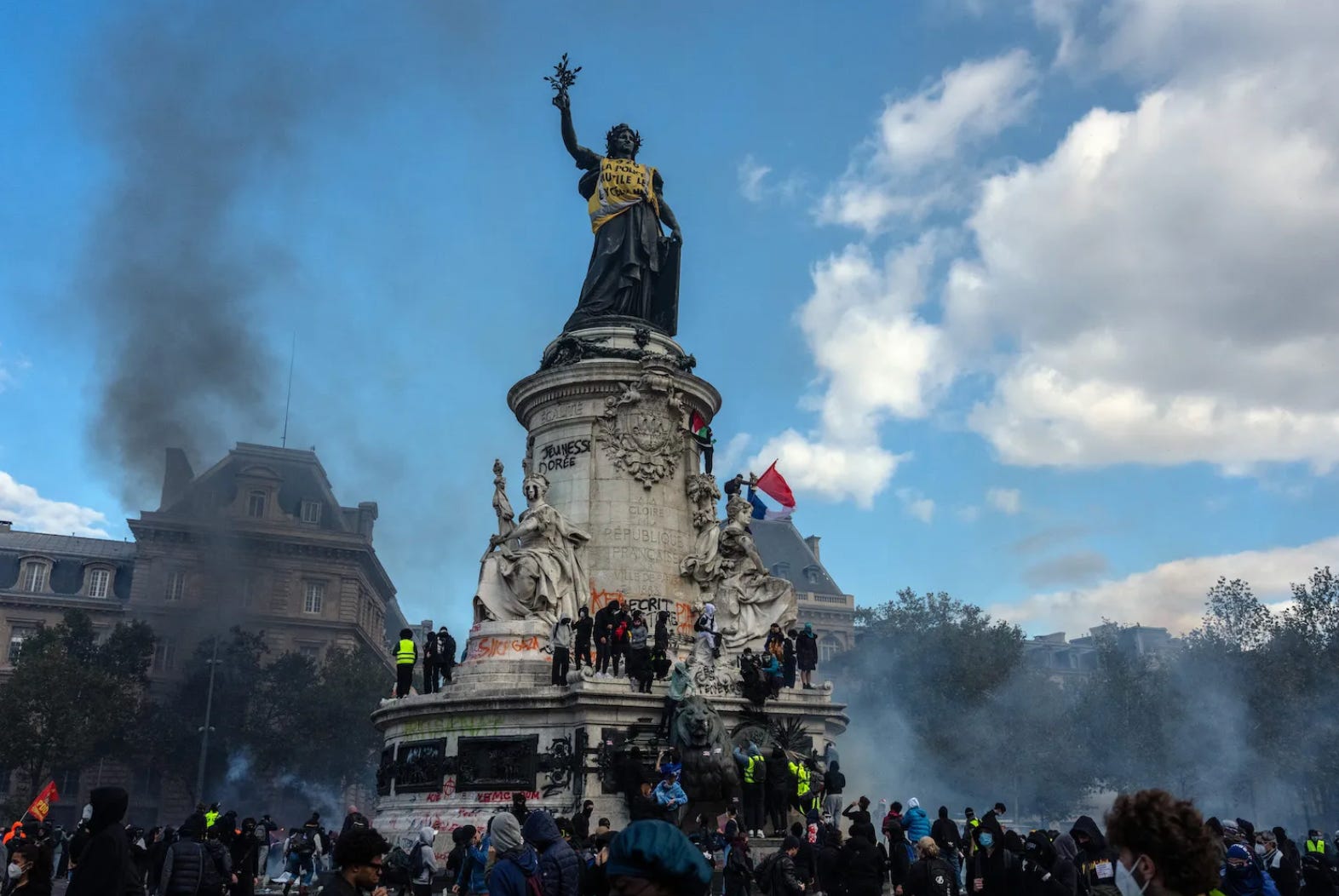
In this essay, Slavoj Žižek uses the 2026 protests in France as a starting point for a broader argument about political unrest, representation, and leadership. He describes the student and labour mobilisations against underfunded public schools, staff shortages, poor infrastructure, and heat-related classroom conditions, then contrasts them with earlier French protest waves such as 1968 and the Yellow Vests movement. From there, he argues that mass unrest often exposes a crisis in political representation but does not automatically translate into an effective political programme. The essay also criticises the responses of major political figures, including Macron, Marine Le Pen, and Jean-Luc Mélenchon, and develops a larger claim about the limits of populism, the fragility of “the people” as a political category, and the need for organised leadership to turn dissatisfaction into durable change.
France’s 2026 protests begin with school and labour anger
Žižek opens with a recap of the protests that began on September 18, 2026, driven by anger over underfunded public high schools, staff shortages, poor infrastructure, and difficult learning conditions. He notes the spread of demonstrations and blockades across France and, to a lesser extent, neighboring countries. He also mentions clashes, arrests, and curfews in some French cities.
Political reactions and blame games
The essay criticises the responses of leading politicians. Žižek presents Marine Le Pen as blaming the far left and immigrants, Mélenchon as offering unclear proposals, and Macron as appearing disoriented. He also cites the government’s claim that a radical minority escalated the unrest and the protesters’ counterclaim that the movement was spontaneous.
From 1968 to the Yellow Vests
Žižek places the protests in a longer historical sequence. He revisits 1968 as a revolt against factory, school, and family, arguing that capitalism later absorbed much of the Left’s anti-hierarchical language. He then turns to the Yellow Vests, describing them as a decentralized movement that shifted attention back to economic grievances and exposed a gap between popular experience and political representation.
Representation, leadership, and the demand for organisation
A central claim of the essay is that spontaneous unrest cannot remain unstructured forever. Žižek argues that protests may express a deeper dissatisfaction with liberal-democratic capitalism, but that dissatisfaction must eventually be turned into a programme through leadership and organisation. He suggests that the failure of representation points not only to political institutions, but also to the contradictions in what representation is supposed to express.
Macron, the Fifth Republic, and democratic instability
Žižek links Macron’s response to the structure of the French constitution and argues that the Fifth Republic allows for a strong presidential logic that can override parliamentary weakness. He frames Macron’s post-2024 political maneuvers as part of a broader French pattern in which institutional design is used to maintain order when electoral choices are unclear.
Badiou’s phrase and the left/right struggle over unrest
The essay returns to Alain Badiou’s line, “Tout ce qui bouge n’est pas rouge,” to suggest that unrest does not automatically belong to the Left. Žižek then twists the phrase for the 2026 protests, arguing that even when protests present themselves as red, they may not truly be so in political effect or organisation.
Key takeaways
- Žižek uses the 2026 French protests to argue that mass unrest reveals failures in political representation.
- He compares the protests with 1968 and the Yellow Vests to show how movements can be absorbed, diverted, or exhausted.
- The essay is sharply critical of Macron, Le Pen, and Mélenchon, whom Žižek sees as inadequate to the moment.
- A major theme is that protest energy needs organisation and leadership to become lasting political change.
- Žižek argues that populist claims about “the people” often conceal deeper contradictions in democracy and capitalism.
Source: Slavoj Žižek, “TOUT CE QUI BOUGE N’EST PAS ROUGE – EVEN IF IT PRESENTS ITSELF AS RED,” published on Substack. URL: https://slavoj.substack.com/p/tout-ce-qui-bouge-nest-pas-rouge-e8c Read the original post on Substack.